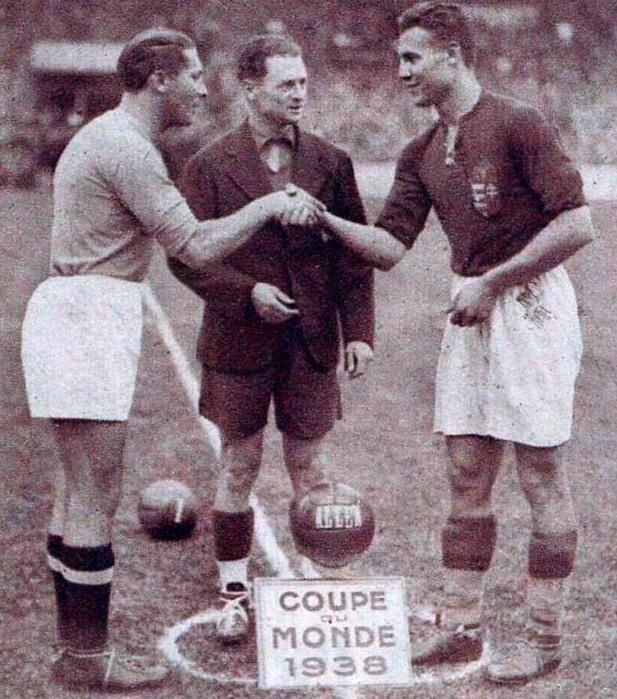
France 1938: the last World Cup before the war, the country that disappeared and Spain unable to compete

- France 1938 was the last World Cup before World War II, marking the end of an era in international football
- Germany disappeared as a participating nation due to the political and military context of the time
- Spain could not participate in the tournament due to its internal situation following the Spanish Civil War
The 1934 World Cup was the first one a regime used as a shop window. The 1938 one was worse: here football wasn't behind politics anymore, it was inside it. An entire country vanished between the draw and the tournament, Spain couldn't even show up, and the final was played fourteen months before the war started.
🇫🇷 The 1938 World Cup by numbers
- Host nation
- France
- Teams
- 15
- Champions
- 🏆 Italy
- Runners-up
- Hungary
- Final
- Italy 4-2 Hungary
- Stadium
- Olympique de Colombes · Colombes
- Attendance
- 45,000
- Top scorer
- Leônidas da Silva (Brazil), 7 goals
A country qualified and vanished from the map
The draw was held in Paris on 5 March 1938. Ten days later, Germany annexed Austria: the Anschluss. Austria was qualified, had one of Europe's best teams and suddenly it wasn't a country anymore.
It withdrew, of course. And its place was left empty, so Sweden advanced to the quarter-finals without playing a match. It's the only instance in World Cup history of a team reaching the knockout stage without kicking a ball: a squad that made the quarters without even touching the ball.
That World Cup kicked off, then, with 15 teams instead of 16.
Germany signed up half of Austria and crashed out first
The Nazis wanted to use the annexation to build a super-team. There's documented evidence of a quota system — six Germans and five Austrians in the starting eleven — and manager Sepp Herberger even called up 38 players, fifteen of them Austrian, to choose from.
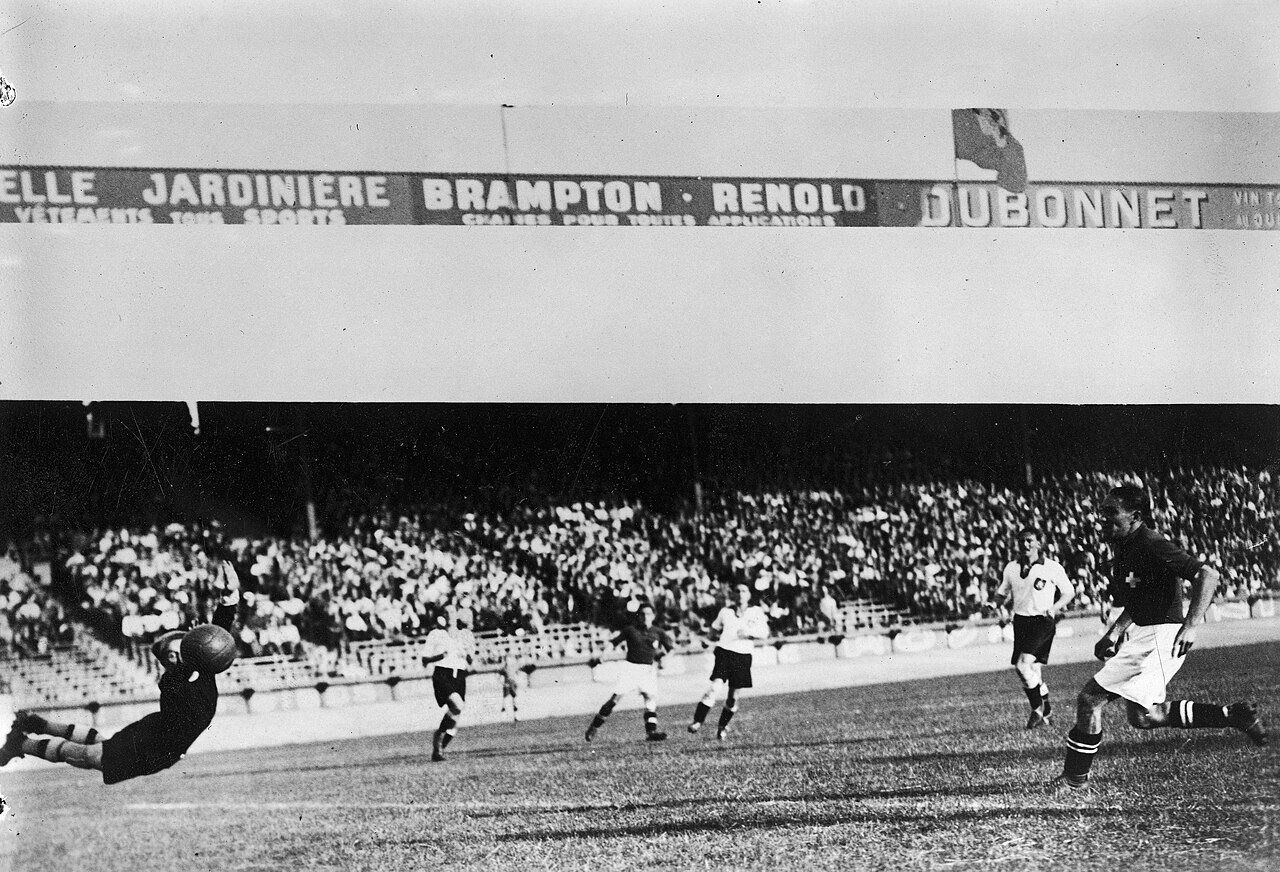
It backfired spectacularly. Germany drew 1-1 with Switzerland in the opening match and lost the replay 4-2, with the Swiss coming back from 0-2 down against a Parisian crowd throwing bottles at them. Knocked out in the first round. They wouldn't fall that early again until 2018.
Herberger himself said afterwards he'd been "forced" to include the Austrians and blamed their "defeatist attitude". A German journalist at the time summed it up better: Germans and Austrians prefer playing against each other even when they're on the same team.
Spain entered the tournament, and the Civil War left them out
This story hardly ever gets told right: Spain wasn't excluded, Spain entered and had to withdraw. They were coming off the quarter-finals in 1934, having knocked out Brazil and stood toe-to-toe with Italy with Zamora, Quincoces, Lángara and Iraragorri. It was a real national team, and they missed the World Cup because the country was at war.
During those years the Spanish national team simply didn't exist. The closest thing to a touring national squad was the Euzkadi selection, which travelled around Europe and America between 1937 and 1938 raising funds for the Republic.
And there's a lovely detail about how much our war weighed on that World Cup: Switzerland refused to travel to Lisbon to play their knockout tie against Portugal because it meant crossing war-torn Spain. The solution? The match was played in Milan. The Civil War literally moved a World Cup qualifier to a different country.
Brazil 6-5 Poland: the wildest match of the tournament
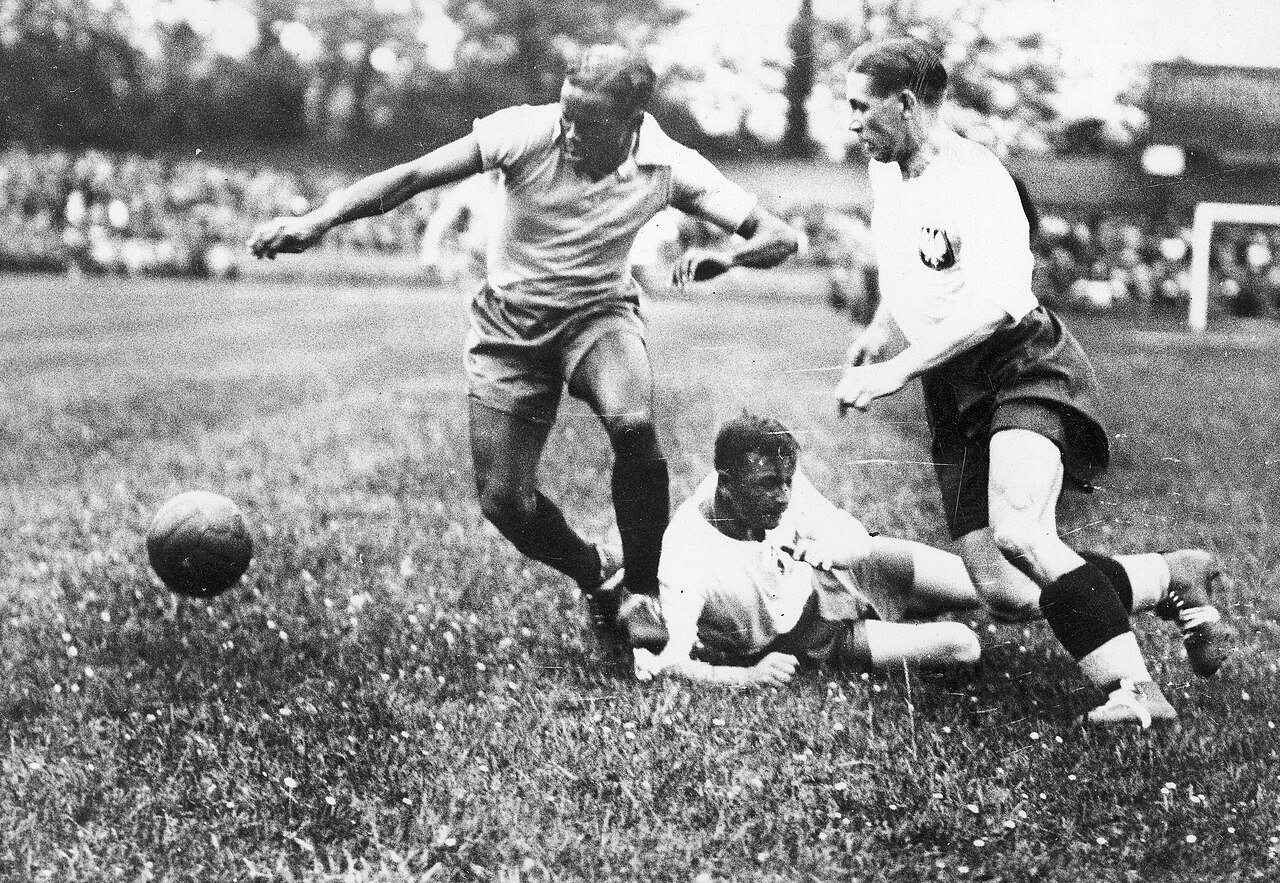
June 5th, Strasbourg, under a deluge. Brazil won 6-5 after extra time in the highest-scoring match in World Cup history at that point. Polish striker Ernest Wilimowski scored four — and lost. He remains the only footballer to score four goals in a World Cup match and get knocked out.
Kit trivia for the nerds: both teams were wearing white, so Brazil played in their blue training kit. It was the first time Brazil wore blue in an official match. Twenty years later, in the 1958 final, that blue would bring them their first World Cup.
The Battle of Bordeaux and football's last ever replay
In the quarter-finals, Brazil and Czechoslovakia drew 1-1 in a match that went down in history for what happened off the ball: three red cards — the first in World Cup history —, goalkeeper Plánička finished with a broken right arm (and continued playing the extra time) and Nejedlý with a broken leg.
With no penalty shootouts back then, they had to replay the match two days later. Brazil won 2-1. It was the last replay in World Cup history: it's never happened since.
The black shirt, and the salute that wouldn't come down
This needs to be precise, because it's told wrong everywhere. Italy wore black just once, in the quarter-final against France, on June 12th at Colombes. It wasn't in the final and it wasn't against Brazil.
And the shirt change wasn't meant to provoke: both teams were wearing blue, they drew lots to see who changed, and Italy lost the draw. What was provocative came after: despite being able to use their usual second kit, which was white, they were ordered to play in a black shirt with the fascist fasces on the chest. Italy won 3-1 and knocked out the hosts.
But the real scene of that World Cup was something else, and Pozzo himself told it in his memoirs. In the opener against Norway, in Marseille, there were around 10,000 Italian exiles in the stands. The players did the fascist salute and got booed to the rafters. Pozzo ordered them to keep their arms up until the crowd quieted down. When they lowered their arms and the whistling started again, he ordered them to do it again: «Team, ready. Salute».
The final: 4-2 and back-to-back titles
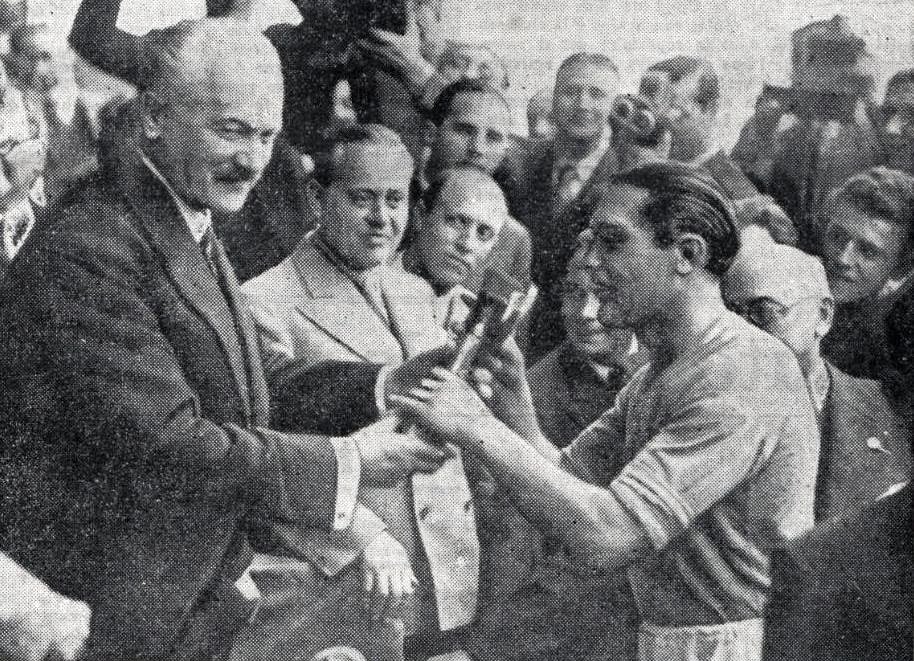
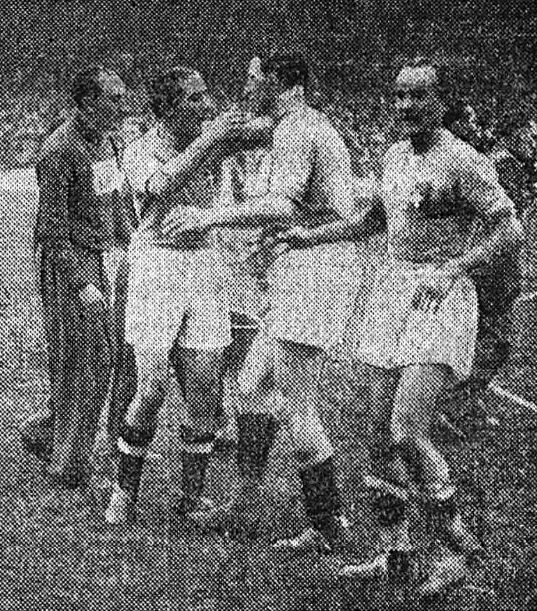
June 19th, 1938, Colombes, 45,000 spectators. Italy 4-2 Hungary, with a brace from Colaussi and a brace from Piola. It was already 3-1 at half-time. French president Albert Lebrun handed the Cup to Giuseppe Meazza.
Organisational quirk: the final and the third-place playoff were played on the same day at the same time. While Italy was winning in Paris, in Bordeaux Brazil came from 0-2 down and beat Sweden 4-2.
That the Black Diamond invented the overhead kick and showed the world at this World Cup.
No. Leônidas is one of several candidates to have popularised it, and the dates attributed to him are 1932 and especially 1948. The oldest lead points to Ramón Unzaga, born in Bilbao in 1894 and who emigrated to Chile as a child, and is recorded executing it in Talcahuano in 1914 — which is why the Argentine press called it «the Chilean». Peru claims the «chalaca» even earlier. What Leônidas did do was make it famous in Brazil.
That his boot broke, he carried on barefoot and scored, and the referee didn't see it because of the mud.
That the barefoot goal is reasonably solid — the best-supported version places it in the 93rd minute, with his right boot lost in the mud and Brazil playing in black socks, which helped it go unnoticed. But there are at least four different versions of how it happened: that the goal was disallowed, that he took his boots off on purpose at the start, that he took both off, that they were being repaired. The fact holds up; the how, not so much.
That Brazil was so sure of beating Italy in the semi-final that they saved their star for the final. Arrogance punished.
That it's false, and was disproved back in 1938. Leônidas was injured: he came out of the 6-5 against Poland damaged, played all 120 minutes of the Battle of Bordeaux and the replay, and didn't make it. Besides, his natural replacement, Niginho, was ineligible because the Italian federation had reported his irregular status to FIFA. Leônidas himself wrote a letter clarifying that the manager had no choice. What was cocky: Brazil had already booked plane tickets from Marseille to Paris for the final, and Pozzo used it to motivate his players. When they lost, Brazil refused to sell the tickets to Italy, who had to go by train.
That Mussolini sent the players a telegram before the final with two words: vincere o morire.
That there's not a trace of the telegram in any archive. Pietro Rava, the last surviving member of that squad, explicitly denied it in an interview in 2001: «No, no, no, that's not true. He sent a telegram wishing us luck, but never "win or die"». Rava died in 2006 and also said something that doesn't fit the legend: Mussolini never actually lifted the trophy.
Sindelar, the man who said no
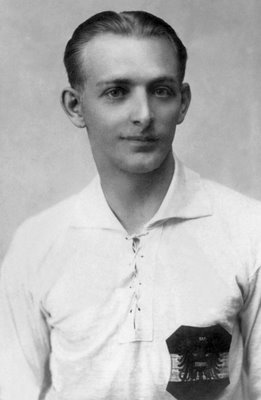
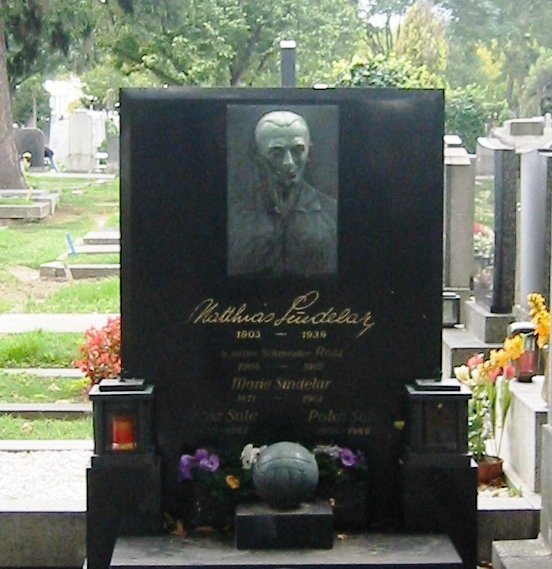
Matthias Sindelar was the captain of the Austrian Wunderteam, his country's greatest footballer of the 20th century. When Germany absorbed Austria and put together a combined national team, he refused to play, citing age and injuries. That's why he wasn't in France.
He died on 23 January 1939 in his Vienna apartment with his girlfriend. The official verdict was carbon monoxide poisoning, and that's where things get murky: three theories exist — accident, suicide and murder — and none of them is proven. The Gestapo had a file on him. A neighbour had reported a faulty chimney days before. A friend of his claimed decades later that he'd bribed an official to have it registered as an accident.
What's worth clearing up, because it keeps getting repeated: Sindelar was not Jewish. The confusion comes from the fact that his club, Austria Viena, was backed by Viennese Jewish bourgeoisie.
And then the ball stopped for sixteen years
The war cancelled the World Cups of 1942 and 1946. That made Italy world champions for sixteen straight years, from 1934 to 1950: a record nobody's going to break.
And there's a story that explains how the Jules Rimet Trophy made it intact to 1950. Italian football boss Ottorino Barassi, FIFA vice-president, took the trophy out of a Roman bank's safe and hid it throughout the war in a shoebox under his bed. If the cup is still there in those Maracanã photos, that's why.
- 1938 FIFA World Cup — Wikipedia
- RSSSF — full 1938 tournament data, entries and withdrawals
- Simon Martin (author of «Sport Italia») on the black shirt, the Marseille salute and the telegram that never existed
- CONMEBOL on the origins of the bicycle kick
- Alex Bellos, «Futebol: The Brazilian Way of Life», for Leônidas's barefoot goal.
- The photos are public domain or Creative Commons via Wikimedia Commons; each one has its author and licence at the bottom.
- The Spanish Wikipedia keeps the debunked version about Leônidas in the semi-finals on this World Cup and misdates the draw: the verified version has been used here.
💬 Comments
Have your say, YouTube-comments style but at home. Be polite — decent folk read this.